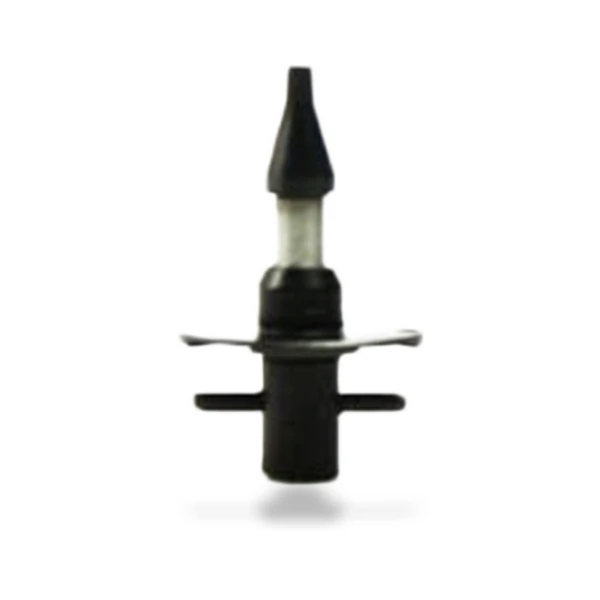
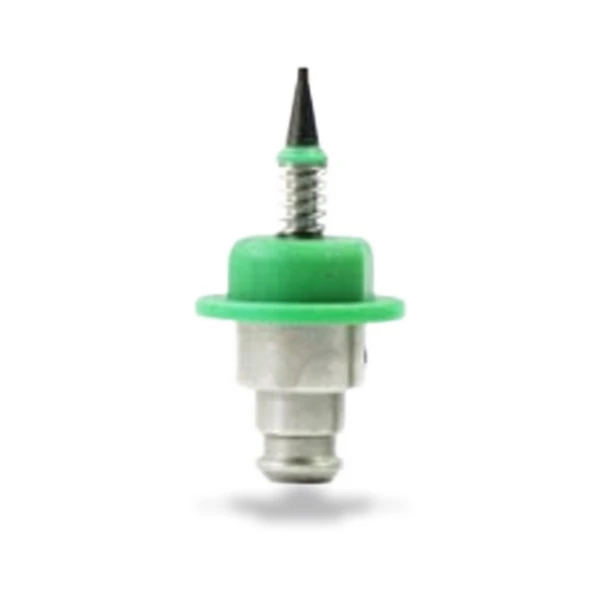
Most wrong-part shipments are not a supplier mistake. They are a suffix problem. A part number that looks right, an invoice that looks right, and a nozzle that will not seat — because the last two characters differ.
Four things hiding inside one part number
An SMT part number usually carries four separate pieces of information, and only the first one is obvious:
- Product family — which head, which platform, which feeder class.
- Variant or code — the specific geometry: opening size, tip shape, tape width.
- Revision — the current release level. Superseded revisions usually still fit, but not always.
- Source/channel marker — an OEM build variant that may change the materials or the mounting face.
Quoting the family and the variant is enough to get a nozzle that looks identical. It is not enough to guarantee it seats.
Fuji: two parallel numbering systems
Fuji uses part numbers (AA05800) alongside legacy codes (R07-010-070). Both remain in circulation — older machine manuals and maintenance sheets quote the legacy code, newer spare-parts systems quote the AA number. The two refer to the same tip, but the legacy number is not always printed on the part.
Fuji also supersedes within a family. The H08 3.7 mm nozzle is listed as AA20D10 and was earlier AA20D00 — same geometry, updated release. When a customer sends an AA20D00 requirement, confirming the supersession takes one line on the quotation and prevents a return.
JUKI: code plus number, and a suffix that matters
JUKI parts are usually referenced by a short code — 500, 501, 503, 508, 511, 515, 517, 561, 7501 — and by a full part number: 40001341 for code 503, E36167290A0 for code 511. Both appear on customer POs.
The trap is the suffix. JUKI nozzles end in A0 or B0, and those are different components: code 561 is E36397290B0, with E3639-729-0B0 as the hyphenated reference. Dropping a character — a common transcription error when a code is read from a machine screen — produces a number that looks plausible and matches nothing.
Panasonic: the N-suffix distinction
Panasonic’s CM402 / CM602 / NPM range uses codes like 110N, 140S, 140SN, 161S, 230C and 230CSN. The trailing N is not decoration: 140S and 140SN are different nozzles with different part numbers (N610043702AB versus N610119473AA). The N variants are not drop-in substitutes for the plain codes.
Panasonic also revises within a code. The 230C is now N610040784AD, having previously been N610040784AB. We quote the current revision and list the superseded one so your BOM reconciles either way.
Yamaha: the prefix carries the head generation
Yamaha numbers look similar across generations, and the prefix distinguishes them: KM0-M711A-31X for code 31A, KGT-M7730-A0X for 203A, KGS-M7710-A0X for 211A. The short codes are convenient on the shop floor but they are not what should reach a purchase order. A nozzle with the wrong prefix may physically enter the holder and still not seal, which shows up as intermittent pick failures rather than a clean error.
Feeders are simpler — and less forgiving
Feeder numbers are usually a clean model designation: KT16C, FF121S, KXFW1L10A00, KLJ-MC100-00. The variables are tape width and generation, not suffix. What matters far more than the number is condition: a feeder is a mechanical assembly with belts, sprockets and springs, and its condition determines your pick rate. Always ask for the tape-advance measurement, not just the model.
Four questions before you send a PO
- What is the head or platform, not just the machine series?
- What is the full part number, including any prefix and suffix, exactly as printed in the manual?
- Is there a legacy or superseded reference your BOM uses instead?
- For feeders: what is the tape width and what advance measurement should the unit meet?
Answer those four and the part is unambiguous. Skip them and the fastest supplier in the world will still ship you the wrong item.