A counterfeit nozzle does not fail on day one. It fails quietly, over ten thousand placements, and the cost shows up in your AOI escape rate rather than your invoice. A nozzle that costs 30% less and lasts a third as long is not a saving — it is a yield problem with a deferred bill.
Why nozzles are the most counterfeited SMT part
Three things make nozzles the ideal target. They are consumed in volume — a 12-spindle head needs twelve of the same part, and a busy line replaces them several times a year. They are small enough to ship in an envelope, so the freight cost is negligible against the part price. And they are dimensionally simple: a copy only has to look right, not measure right.
The last point is the dangerous one. A copied nozzle body can be dimensionally close enough to seat correctly while the internal vacuum bore, the tip chamfer or the ceramic insert is out of tolerance. It picks up parts in first-article testing. It starts dropping them at week three.
Six checks that catch most copies
1. The part number, not the label
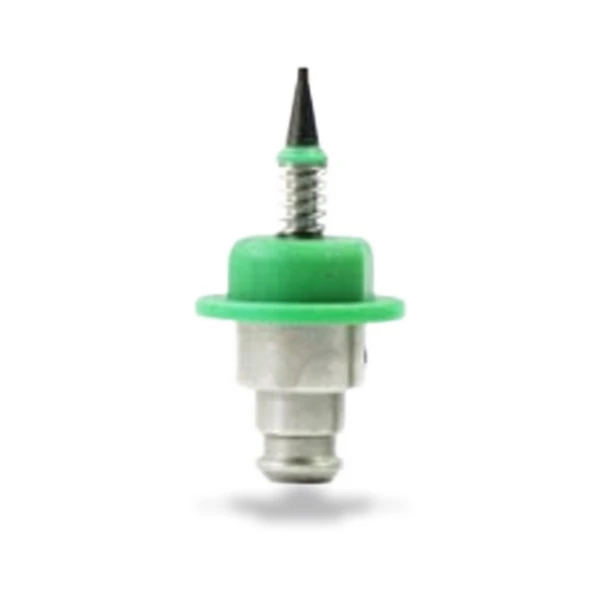
Genuine Fuji, JUKI, Panasonic and Yamaha nozzles carry their part number laser-marked or stamped on the body. Check the marking against the number you ordered and against the legacy reference. A Fuji H08 1.0 mm nozzle should read AA05800, with R07-010-070 recognised as the older Fuji code — not one number replaced by the other.
Counterfeits frequently carry the correct-looking code on the bag and nothing on the part.
2. Weight and surface finish
Put the suspect next to a known-good nozzle of the same code on a jeweller’s scale. Copies are usually lighter — thinner wall sections, a different alloy, or a plastic insert where the original uses ceramic. Run a fingernail along the tip: a genuine tip face is consistently machined; a copy often shows a slight burr at the bore edge that will hold onto fine dust.
3. The vacuum bore, measured — not eyeballed
This is where the real difference lives. Bore diameter and concentricity control how much vacuum reaches the component. A pin gauge set or a bore scope takes two minutes per unit and is the single most reliable field test. Any supplier unwilling to send you a bore measurement for the specific units in your order is telling you something.
4. Colour and hardness of the tip coating
Original tips use a defined coating for wear resistance. Copies are frequently hard-anodised to look similar but wear through in weeks. A light scratch test on a sacrificial unit, or a hardness check if you have one, exposes the difference quickly.
5. Packaging consistency across the batch
Order twenty units and compare them. Genuine production nozzles come in consistent anti-static tubes or trays with a stable label format, batch marking and — for OEM-channel parts — a traceable carton label. Mixed label formats inside one order usually means mixed sources.
6. Ask for the photo before you pay
The cheapest protection available: ask the seller to photograph the actual units in your order, tip down, next to a ruler or a marked reference. Not a catalogue image — your units. A trader holding real stock can do this in ten minutes. A trader drop-shipping from an unknown source cannot.
What the price difference really is
On mainstream codes — Fuji H08 series, JUKI 50x series, Panasonic 140S and 230C, Yamaha 31A — genuine original stock typically lands 20–40% below OEM list, and copies undercut that by another 30–50%. The arithmetic only works in the copy’s favour if the part lasts as long, which it does not.
| Cost of a nozzle over 12 months | Genuine original | Low-cost copy |
|---|---|---|
| Unit price index | 100 | 55 |
| Units consumed per head per year | 1.2 | 3.4 |
| Effective annual cost index | 120 | 187 |
| Unplanned line stops attributed to nozzle variation | low | elevated |
| Scrap and rework at the AOI stage | baseline | typically higher, rarely measured |
The second row is the one buyers forget. Consumption rate — not unit price — drives the annual cost, and consumption rate is set by bore wear and tip condition.
A short receiving checklist
- Match laser marking on the body to the ordered part number and its legacy reference.
- Weigh three units against a known-good reference; flag anything more than a few percent light.
- Pin-gauge the bore on a sample — record the number, keep it with the batch.
- Inspect the tip face at 10× for burrs and coating uniformity.
- Run a first-article placement check and log the pick rate for the first shift.
- File the supplier’s pre-shipment photo with the batch record, so a later dispute has evidence.
What we do differently
Every nozzle we list is photographed in our own warehouse — the photo on this site is the unit, not a stock rendering. Part numbers and legacy cross-references are verified on receipt and printed on the invoice, so your BOM and our shipment agree on paper before anything moves. Where a customer wants it, we will send bore measurements or a side-by-side comparison against the nozzle they are currently running.